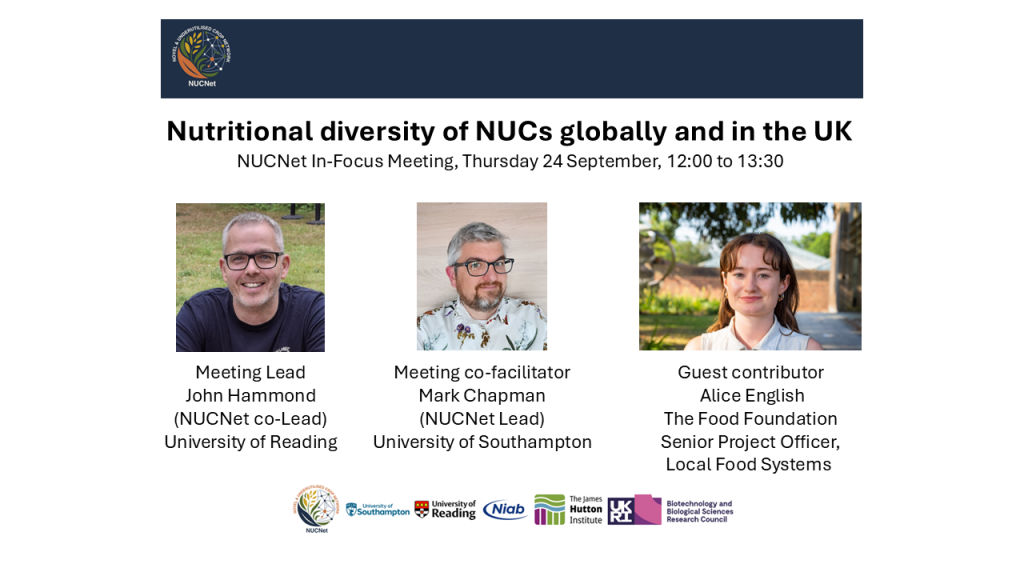
Thank you to John Hammond, NUCNet Co-Lead, and Alice English, Senior Project Officer for Local Food Systems at The Food Foundation, for co-hosting NUCNet’s first In-Focus Meeting. We were delighted to welcome so many network members and to benefit from the wealth of knowledge, experience and insights shared throughout the discussion on Nutritional Diversity of NUCs Globally and in the UK.
The attendee profile demonstrated the breadth of NUCNet’s community, with participants joining from across England, Scotland and Wales, alongside international representation, and with attendees from all career stages and sectors.
This diversity of perspectives provided an excellent foundation for interdisciplinary discussion and future collaboration across the network.
Mark Chapman, NUCNet Co-Lead, opened the meeting with an introduction to the network, outlining what constitutes a novel and underutilised crop (NUC), introducing the people leading NUCNet, and highlighting the network’s activities, funding opportunities and ambitions.
The focus of the meeting was the role of NUCs in supporting nutritional diversity and resilience within food systems. John Hammond began by outlining the environmental changes reshaping agriculture and food production. Drawing on evidence of climate impacts on crop yields, he highlighted the urgent need to adapt food systems to changing conditions and explored the limited diversity of crops currently grown and consumed. He discussedhow future climatic changes could further reduce the nutritional quality of food, reinforcing the case for broader adoption of novel and underutilised crops.
Alice English followed with a presentation on The Food Foundation‘s Bang in Some Beans campaign. She explained the motivation behind the initiative, its key objectives, and the progress made during its first year. Early successes include increased bean sales, greater public awareness and conversation around beans, and increased bean consumption among schoolchildren. The campaign provided an excellent example of how targeted initiatives can influence dietary habits and encourage healthier, more sustainable food choices.
Key Discussion Points
Driving Change Across the Food System
The discussion highlighted the wide range of stakeholders needed to drive change, from researchers, agronomists and farmers to supply chains, retailers, policymakers and consumers. Participants noted that modern lifestyles often leave people with less time to prepare meals, contributing to greater reliance on convenience foods and food delivery services. The importance of developing farming systems that deliver both productivity and sustainability was also discussed, including examples of alternative crop management approaches.
Building Consumer Demand
Consumer demand was identified as a key factor in supporting wider adoption of novel and underutilised crops. Participants explored the roles of both large-scale and small-scale agriculture, noting that smaller production systems can enhance resilience, strengthen local food networks and increase diversity within supply chains.
The discussion also considered the factors influencing consumer food choices, including taste, familiarity, seasonality, availability and affordability. Participants reflected on how the wider food environment, including the prominence of fast-food outlets, can shape consumption patterns and influence dietary diversity.
Policy and System-Level Change
Policy was recognised as an important lever for change. Participants discussed the influence of dietary guidelines, agricultural policy and subsidy schemes in supporting farmers to take risks and diversify production. There was also a strong consensus that progress will require a whole-system approach, with governments, industry and other major stakeholders sharing responsibility for supporting the transition towards more diverse and sustainable food systems.
Several contributors highlighted opportunities for stronger policy support to encourage the production and consumption of pulses and legumes, given their potential benefits for both human health and environmental sustainability.
Food Security and Supply Chain Resilience
The discussion also highlighted the UK’s reliance on imported food. Participants noted that a substantial proportion of the fruit consumed in the UK is imported, in many cases from countries more exposed to the effects of a changing climate, raising questions about the long-term resilience and sustainability of existing supply chains. The group considered the potential risks posed by climate change and other global shocks, reinforcing the need to strengthen domestic production and increase the diversity of crops grown within UK food systems.
Opportunities for Progress
The meeting concluded with discussion of practical opportunities to accelerate change. Suggestions included strengthening support for home-grown crops, encouraging retailers to source more produce from UK suppliers, reducing reliance on pesticides where appropriate, increasing the availability of plant-based options in public and commercial catering, and using education and communications to encourage healthier and more diverse dietary choices from an early age.
The lively discussion highlighted both the challenges and the opportunities associated with improving nutritional diversity within UK food systems. We thank all attendees for contributing their expertise and look forward to continuing these conversations through future NUCNet In-Focus Meetings.